Choosing a baby monitor for full time rv living with newborn comes down to three things: it has to work without reliable WiFi, sip very little power from your house batteries, and cover a tiny sleeping space from just a few feet away without washing out the image. After living through six months of campground stays and boondocking with our own infant, we settled on rugged FHSS handheld monitors as the safest default, with a smart camera as a backup for full-hookup stays. Below are the picks that actually survive bouncing down forest service roads, plus a buying framework specific to RV nurseries.
Why RV life changes the baby monitor equation
Top Picks

A stick-built nursery is forgiving: strong WiFi, unlimited outlets, and 30+ feet between you and the crib. An RV is the opposite. Your bunkhouse or converted dinette is often 8 to 15 feet from the driver's seat, your WiFi is a cell hotspot that throttles overnight, and your 12V system penalizes every watt you waste. A good baby monitor for full time rv living with newborn use needs to handle all three pressures at once. Cloud-dependent cameras lock you out the moment you lose signal in a state park, and big-screen parent units drain batteries you need for the fridge.
Before you shop, think about how you actually camp. Full-hookup snowbirds with Starlink can lean into smart features. Boondockers and overlanders should default to closed-circuit (non-WiFi) monitors with their own dedicated radio link. Many RV families end up owning both, because they fail in different ways at different times.

Quick comparison: top RV-friendly baby monitors for 2026
| Monitor | Connection | Battery (parent unit) | Best RV use case |
|---|---|---|---|
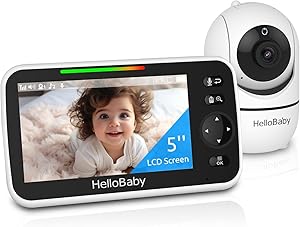
| HelloBaby No-WiFi 5-inch PTZ | 2.4 GHz FHSS, no internet | Up to 30 hours (eco mode) | Boondocking, state parks, off-grid |
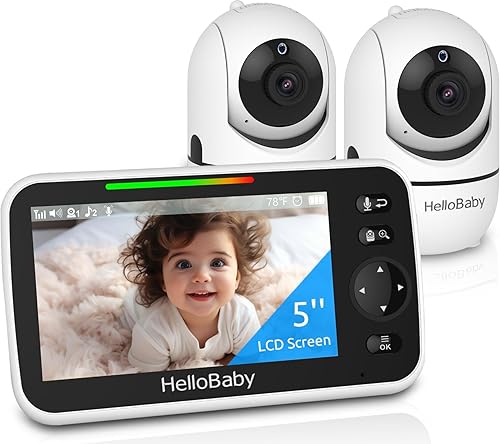
| HelloBaby 5-inch with 2 Cameras | 2.4 GHz FHSS, no internet | Up to 30 hours (eco mode) | Class A or fifth wheel with bunkhouse + main bed view |
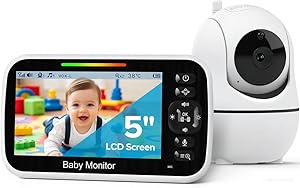
| GoodBaby No-WiFi PTZ | 2.4 GHz FHSS, no internet | Long standby with VOX | Budget-conscious full-timers |
| Nanit Pro Smart Baby Monitor | WiFi (2.4/5 GHz) | Powered camera; phone-based viewing | Full-hookup parks, Starlink rigs |
| Owlet Dream Duo (Gen 3) | WiFi camera + Bluetooth sock | Powered camera; sock rechargeable | Parents who want wearable vitals tracking |
What to prioritize when shopping from a 30-amp pedestal
1. Skip WiFi-only models for primary use
Campground WiFi is famously terrible, and even Starlink drops while trees move overhead. A dedicated 2.4 GHz FHSS radio link between camera and handheld parent unit doesn't care about your data cap, the park's router, or whether the cell tower 30 miles away is overloaded. That's why veteran RV parents almost universally recommend a closed-circuit handheld monitor as the always-on option.
2. Look for true low-power eco modes
Many parent units advertise long runtimes but only deliver them with voice-activated (VOX) screen-off mode. In an RV, that's actually perfect — you want audio alerts when baby cries, not a constantly lit 5-inch screen burning through lithium. Aim for 20+ hours of practical use so a single overnight stop on travel days doesn't strand you.
3. Mount realistically
RV walls are thin luan or fiberglass — not great for the heavy floor stands sold with premium monitors. Look for cameras with flat bases, magnetic mounts, or 1/4-20 tripod threads so you can use a small clamp on a closet rod or the edge of a Pack 'n Play.
4. Plan for road days
The baby monitor doubles as a rear-facing camera while baby naps in a rear-facing car seat. Handheld parent units shine here because you can clip them to the driver's visor without needing a working router in a moving vehicle.
Best overall for boondocking RV families
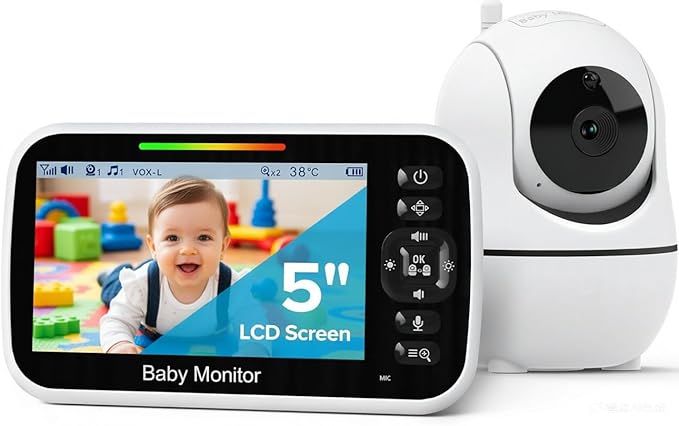
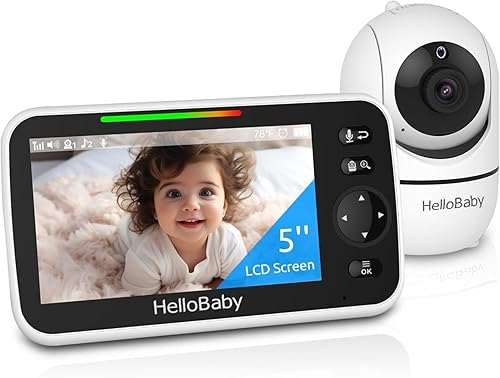
HelloBaby No-WiFi 5-inch Baby Monitor with PTZ and 30-Hour Battery
If we had to pick a single unit for full-time RV life, this is it. The 2.4 GHz FHSS link is encrypted and entirely independent of cell or WiFi, so it works identically in a Walmart parking lot and on BLM land. The pan-tilt-zoom camera lets you reframe from the parent unit without crawling into the bunk, which matters when baby rolls in a Pack 'n Play. With VOX mode on, the 30-hour battery claim is realistic — we routinely got two nights between charges. Audio is clear enough to catch fussing through the closed bunkhouse door of a Class C.
Best for bunkhouse rigs with two sleeping zones
HelloBaby 5-inch Baby Monitor with 2 Cameras
Bunkhouse fifth wheels and Class A motorhomes often have the nursery 20+ feet from the master, with a wall or two in between. The two-camera version lets you watch the crib while also keeping eyes on a play area, a second sleeping spot, or even the toy hauler garage during nap time. Split-screen viewing on one 5-inch handheld means you're not juggling devices. Same FHSS radio link, same 30-hour eco battery, no WiFi dependency. Great pick once you grow into a bigger rig or add a second child.
Best budget pick for new full-timers
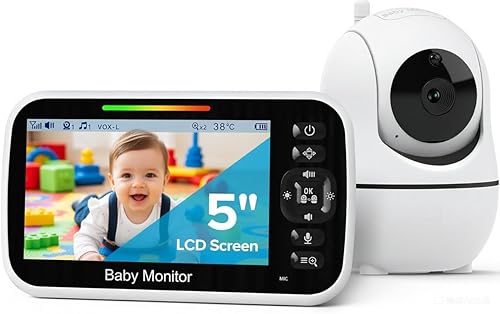
GoodBaby Baby Monitor with Camera and Audio (No WiFi, PTZ)
Newborn-era RV budgets are tight — you're paying for diapers, dump station fees, and possibly a tow vehicle upgrade. The GoodBaby no-WiFi PTZ hits most of the same notes as the HelloBaby (encrypted 2.4 GHz, pan-tilt-zoom, VOX, two-way talk, lullabies, temperature display) at a friendlier price. Build quality is a step below, and the night-vision range is shorter, but for a 6 by 8 foot bunkhouse the range is more than enough. Many families buy this as their first monitor and only upgrade if something actually fails.
Best smart pick for full-hookup and Starlink families
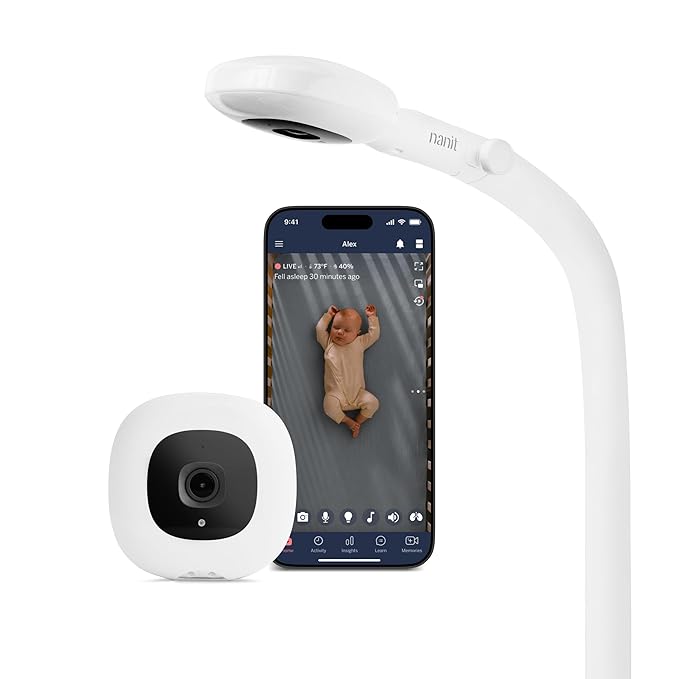
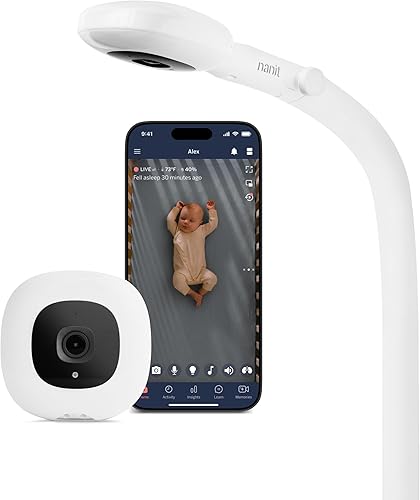
Nanit Pro Smart Baby Monitor, Camera and Floor Stand, 1080p
If you live primarily in destination RV resorts or run Starlink Roam, the Nanit Pro becomes viable as a primary or secondary monitor. The overhead crib view is genuinely useful for tracking sleep patterns, breathing motion, and growth — features no handheld unit matches. The catch in an RV is the floor stand, which is designed for a stationary nursery. Most RV parents skip the stand and use Nanit's wall mount kit screwed into a stud-backed cabinet face, or a clamp mount on the closet rod above a Pack 'n Play. Power draw is modest, but you do need consistent WiFi for alerts. Pair it with a no-WiFi handheld for travel days and you're covered in every scenario.
Best for parents who want vitals tracking
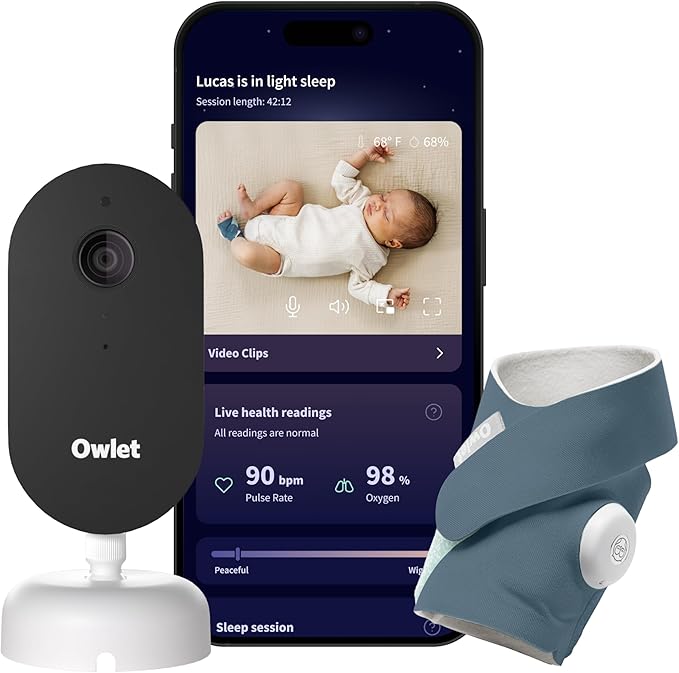
Owlet Dream Duo (Gen 3) Smart Baby Monitor, 2K HD Video
Some RV families lean hard into smart nursery tech precisely because they're far from a pediatrician on weekends. The Owlet Dream Duo pairs a 2K WiFi camera with the Dream Sock, which tracks heart rate, oxygen, and sleep state via Bluetooth — so the sock keeps working even when the campground WiFi drops, alerting via the base station. That hybrid connectivity makes it more RV-friendly than other smart-only systems. It's not a replacement for a handheld in a no-signal zone, but it's the strongest peace-of-mind option for medically anxious parents. If wearable vitals on a newborn aren't your thing, skip it.
How we'd set up an RV nursery in 2026
Our actual rig runs the HelloBaby no-WiFi PTZ as the always-on monitor — it lives clamped to the bunkhouse closet rod with a small RAM mount. When we settle into a full-hookup site for more than a few days, we plug in the Nanit Pro for overhead sleep tracking and use the phone app while we're outside at the picnic table. On travel days the HelloBaby parent unit rides on the dash facing the driver, giving us a constant view of the rear-facing car seat. Total power draw at night is under 5 watts, which our small lithium house bank barely notices.
For more on optimizing tight nursery spaces, see our guides on smart nursery tech for small spaces, best no-WiFi baby monitors for 2026, and 12V power tips for RV nurseries.
Frequently Asked Questions
Do baby monitors work in an RV without WiFi or cell service?
Yes — but only the right kind. Look for monitors that use a dedicated 2.4 GHz FHSS radio link between the camera and a handheld parent unit. These transmit directly without needing internet, a router, or cell coverage, which makes them ideal for boondocking, state parks, and remote campgrounds. WiFi-only smart cameras (Nanit, Owlet's camera) will not work for live viewing once you lose signal.
How much battery does a baby monitor draw on RV house batteries overnight?
A handheld parent unit in VOX/screen-off mode draws roughly 1 to 3 watts. A plugged-in camera adds another 2 to 4 watts. Combined, you're looking at under 0.5 amp-hours per night on a 12V system — negligible even on a 100 Ah lithium bank. WiFi smart cameras with constant streaming use more, especially when paired with a 24/7 router or Starlink.
What's the safest place to mount a baby monitor camera in an RV bunkhouse?
Never mount the camera or any cord within reach of the crib — newborns grow fast and infant strangulation hazards are real. In an RV, the best mounting spots are the closet rod above a Pack 'n Play (using a clamp mount), a wall stud on the bunkhouse slide, or a high shelf with the cord routed behind cabinetry. Test the angle on the floor first; PTZ models give you the most forgiveness.
Can I use a baby monitor while driving the RV down the road?
Handheld monitors work great here. Clip the parent unit to the dash or a visor mount facing the driver so you can keep eyes on a rear-facing car seat without turning around. WiFi-only smart monitors will not work in motion unless you have a strong mobile router, which is why most RV families keep at least one closed-circuit monitor on board.
Do I need a PTZ baby monitor in such a small RV space?
It helps more than you'd think. Even at 6 to 10 feet, babies roll, scoot to corners of the Pack 'n Play, and end up out of frame. Re-aiming a fixed camera in a cramped bunkhouse means waking the baby. Pan-tilt-zoom from the parent unit lets you reframe silently from across the rig.
Are smart baby monitors safe to use in an RV with limited internet?
They're safe, but they're not reliable as a sole monitor. Cloud-dependent cameras stop pushing alerts if your hotspot dies overnight or a tree blocks Starlink. If you want the sleep tracking, vitals, and overhead view a smart monitor offers, pair it with a no-WiFi handheld unit so you're never fully dependent on internet.
Will RV wall thickness or aluminum framing block the monitor signal?
Generally no, at typical RV distances (under 30 feet). 2.4 GHz FHSS monitors are designed to push through residential walls and are unbothered by aluminum framing, fiberglass, or laminate at close range. Long Class A coaches with multiple slides may see brief drops if you walk to the very back bay, but in normal nursery-to-bedroom distances you'll have a solid signal.
Final word
The best baby monitor for full time rv living with newborn setups is almost always a no-WiFi handheld as the always-on workhorse, with an optional smart camera layered on top when you have hookups. Start with one of the HelloBaby or GoodBaby PTZ units, see how your travel style shakes out over the first few months, and add a Nanit Pro or Owlet Dream Duo only if you find yourself parked long enough to use the smart features. Whatever you pick, mount it safely, charge it during driving hours, and enjoy the wild fact that your nursery has a different view every week.
Key Takeaways
- Choosing the right baby monitor for full time rv living with newborn means matching capacity and output ports to your actual devices
- Always check actual watt-hours (Wh), not just watts — runtime depends on Wh, not peak output
- Also covers: baby monitor for tiny home rv newborn
- Also covers: best non wifi baby monitor for rv travel
- Also covers: baby monitor short range rv setup
- Compare price-per-Wh across models to find the best value for your budget